
Meriwether Projected vs Actual Release
“Projected release date” can describe three different records in Meriwether County. For a person at the county jail, it may be a local sentence calculation or merely an expected bond-processing point. In GDC custody, it may refer to maximum-term timing shown through sentence administration. In the parole system, the date may be a Tentative Parole Month or a final parole date.
A pretrial detainee normally has no sentence-expiration date. The person may leave after posting bond, a judge changing conditions, charges being resolved, or another legal event. A future hearing date is not a release date. Likewise, disappearance from a current roster does not prove community release because a transfer to another county, GDC, federal custody, or immigration custody can remove the person from the local list.
For a sentenced person, the controlling agency may calculate a maximum term and apply only the credits or parole rules allowed for that sentence. Ask which date the record displays before describing it as final. GDC maximum-term timing, a Board TPM, and a county jail estimate do not have the same legal effect.
Find a Meriwether Inmate Release Date
Start with the facility and sentence instead of entering a name into every locator. Meriwether County Jail, GDC, and the Parole Board maintain different records. The official sheriff page did not provide a release-date calculator, so a local date must be confirmed with the jail or court.
- Collect the full name, birth date or age, booking date, case number, GDC ID if known, and current or last facility.
- For Meriwether County Jail, call the Jail Division at 706-672-4489. Ask whether the person is pretrial, serving a local sentence, held for another agency, or awaiting transfer.
- Check the Meriwether County court file for bond, sentencing, modification, revocation, or release orders. The court record explains why a jail date may change.
- For state custody, enter through the GDC Find an Offender form, accept its disclaimer, and search by name, GDC ID, or case number.
- If parole timing is the question, use the Board's Inmate TPM Lookup and read the result as tentative unless a final date is expressly shown.
- Verify a critical GDC result through written correspondence with Inmate Records and Information, PO Box 1529, Forsyth, GA 31029.
The GDC query supports active offenders, inactive offenders not currently incarcerated, or both. Search fields include name, gender, race, age range, institution, physical descriptors, sentence status, primary offense, conviction county, and search scope. A direct panel also accepts a GDC ID or case number. These options help separate similar names and distinguish a released state prisoner from someone still incarcerated.
| Search field | Use in a release-date check |
|---|---|
| Active offenders | Looks for a person currently in GDC custody |
| Inactive offenders | Finds people not currently incarcerated by GDC |
| Max Prison Term Ending Next 15 Days | Filters a near-term maximum sentence window |
| Released In The Past 15 Days | Checks a recent completed GDC release window |
| GDC ID or case number | Narrows the result to a known record |
The broader Meriwether released-inmate search guide covers records needed when a name has already dropped from local custody.
Georgia Credits in Meriwether Release Dates
Georgia does not support a simple universal claim that every state prisoner serves 85 percent. The rules depend on the offense, sentence date, mandatory minimum, parole eligibility, GDC administration, and credit eligibility. O.C.G.A. Section 17-10-6.1 restricts parole, earned time, early release, work release, and other reductions for serious violent felony sentences, subject to narrow provisions. O.C.G.A. Section 42-9-45 supplies general parole eligibility but also recognizes exceptions.
GDC's Performance Incentive Credit program, or PIC, offers eligible state offenders a way to reduce length of stay through progress in reentry case plans, cognitive programs, education, vocational activity, work details, and good conduct. The research source states that one point equals one month and that credit can total up to 12 months. The Parole Board determines eligibility.
Exclusions identified in the GDC material include a death sentence, life sentence, a sentence of two years or less, and a non-parole-eligible offense. Completion of an activity does not mean every person receives the same credit. Approved points, eligibility changes, and discipline can alter the projected result.
If a person is serving a county sentence, ask the jail to identify the start date, credited time, sentence length, and any recognized adjustment. Do not import a GDC credit rule into a local jail calculation. Near a weekend or holiday, verify processing directly because no Meriwether-specific early or delayed release rule was found.
Why Meriwether Release Dates Change
A date can move because it combines legal and administrative decisions. The event that changes a county jail estimate may be different from the event that changes a state-prison projection. Ask the record holder which factor was applied rather than guessing from the new date.
| Factor | Possible effect |
|---|---|
| Bond or court order | Creates, advances, delays, or cancels a local release path |
| Outside detainer or hold | Prevents community release or causes transfer to another agency |
| Sentence correction | Changes the controlling term or credited custody time |
| PIC or other authorized credit | May reduce an eligible state offender's length of stay |
| Discipline or unmet programming | Can affect credit or tentative parole timing |
| Parole grant or denial | Creates a parole path or leaves the sentence timing in control |
| TPM reconsideration | May postpone, cancel, or revise tentative parole timing |
The Parole Board's TPM guidance describes a file-based process. Investigators review arrest and court records, personal history, institutional conduct, programming, work, and submitted input. For most non-life cases, the Board may establish a future TPM or deny parole. A TPM remains conditional and can change before release because of misconduct or unmet preconditions.
A majority vote is required to grant clemency. Public results may not expose every internal decision, so the absence of a detailed explanation in the TPM tool should not be filled with assumptions. A final release date should be distinguished from the month in which final review is expected.
Confirm a Meriwether Release Date
Use the agency that controls the custody. For a county detainee, call the Sheriff's Office or request the jail record, then compare it with the court order. For a state prisoner, read the GDC record and, if parole is involved, the Board record. Written GDC verification is especially important because the offender-search disclaimer says accuracy and completeness are not warranted.
Georgia VINELink can provide a custody-change alert when a participating agency sends data, but it is not the final legal record. Registering before the expected date can help catch a release or transfer event. The Meriwether VINE inmate check explains the name or ID search and phone, email, text, or app notification steps.
If no result appears, test alternate spelling and confirm the system. A person may be in another county, GDC, BOP, or ICE custody. Federal and immigration locators do not turn a Meriwether jail projection into a federal release date; they answer whether another custody system may now be involved.
Georgia's 15-Day Release Window
Georgia's state-prison search uses a window that differs from the 24-hour and 72-hour phrases often used for county jail releases. The GDC form includes “Released In The Past 15 Days” and “Max Prison Term Ending Next 15 Days.” These filters are useful for people tied to a Meriwether conviction who entered state custody.
The first filter looks backward for a completed GDC release status. The second looks ahead to a maximum prison term ending soon. Neither is a county feed, and neither proves that the person walked out of Meriwether County Jail. A state inmate may also face a detainer, parole condition, transfer, or other custody event.
Meriwether County's official site did not provide a separate county jail 24-hour or 72-hour public release window. That absence makes system identification essential: use the jail and court for county custody, but use the GDC 15-day filters only for Georgia state corrections records.
The screenshot of the GDC offender-search entry shows the official gateway used before a state release-date query.
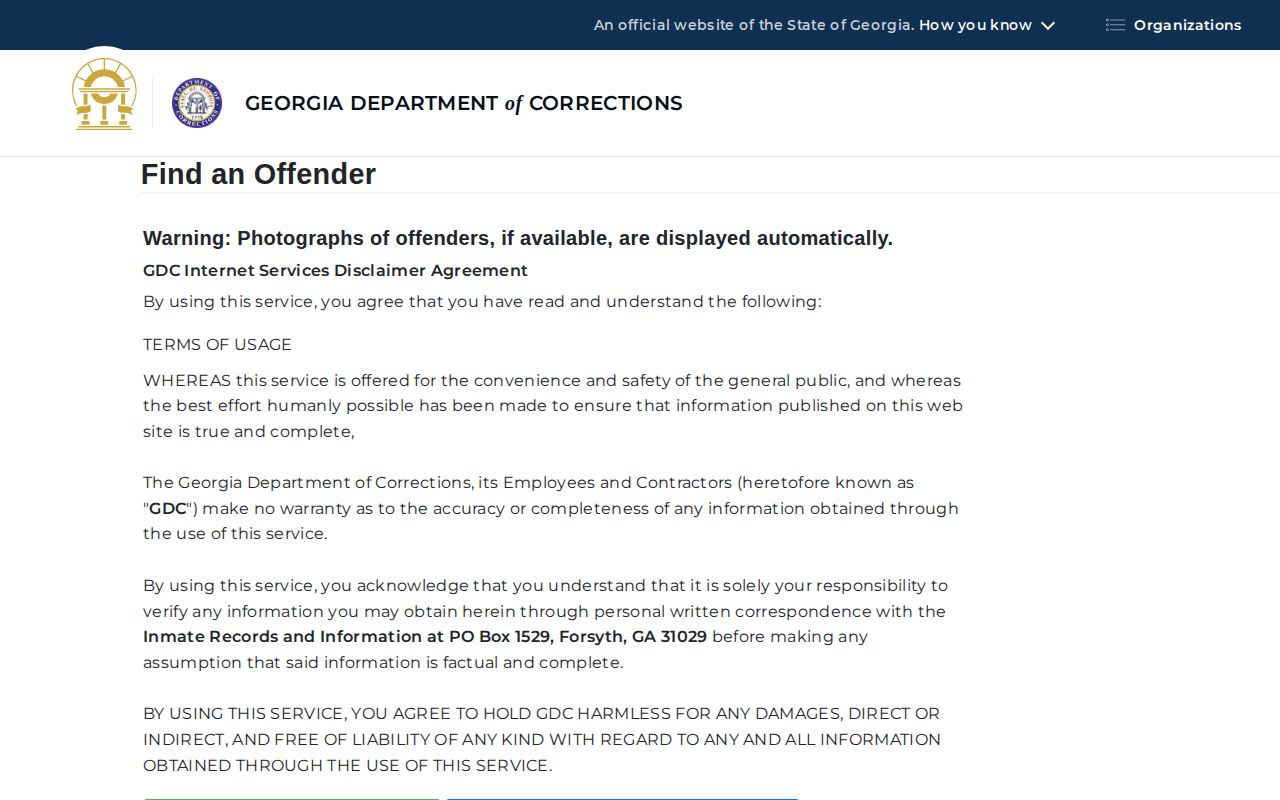
The disclaimer reinforces why a public date should be checked with GDC Inmate Records when formal confirmation is required.